Tuesday, April 9, 2013
IRAN HOLDS INAUGURAL FILM FESTIVAL IN UGANDA
THE West may view the Islamic Republic of Iran as a nuclear threat, undemocratic and a sponsor of terrorism – but this will not stop Tehran exporting its rich culture to the rest of the world.
Between 2006 and 2010 the UN ratified four rounds of sanctions against Iran in reaction to its refusal to halt uranium enrichment and co-operate with the International Atomic Energy Agency (IAEA). In addition, it also faces EU and many other bilateral sanctions.
Iran insists its nuclear energy programme is entirely peaceful and terms the sanctions as “bullying” pressures from the West.
One of the ways of shifting away from the image of a “Rogue State” as portrayed by the West, Iran is to promoting its cultural heritage through the export of its cinematic productions, among others.
The Cultural Council of Iran has just presented the inaugural Iranian Film Festival in Uganda that took place at the National Theatre in Kampala from February 1 - 3, 2013, where eight films celebrating the rich Iranian culture were screened. All films were acted in Persian with English subtitles.
The festival opened with the 2005 drama film “So Far, So Close.” Directed by Seyyed Reza Mir-Karimi the 121-minute film is about a man's beliefs. It revolves around Dr. Alam (Masoud Rayegan) a skilled brain surgeon who has just returned to Iran. He is so engrossed in his professional work that he pays less attention to his family.
Dr. Alam doesn't believe in God. "We, ourselves make God, till we beg His generosity when we need Him,' he often says. As "Nowrouz", the Iranian New Year approaches, he learns that his only son Saman has an inoperable brain tumour and is dying soon. He laments why his own hands have saved lives but will not save his son’s life.
Saman is a student of astronomy and is accompanying his friends to the desert to observe the stars. Dr. Alam embarks on a desert trip to find his son. A series of near-death experiences makes him rethink his views of God. His car runs out of fuel in the middle of the desert without food and water. Because of the poor communication in the area he cannot alert Saman of his predicament. He is saved by his son after his car gets consumed in a strong desert sand storm.
“So Far, So Close” was Iran's submission in the Best Foreign Language Film category for the 2005 Oscars.
“The Kingdom of Solomon (2010)” directed by Shahriar Bahrani is religious-historical film recounting the life of Prophet Solomon based on the Holy Qur’an.
Solomon (Prophet and King), has asked God to give him an ideal kingdom, which has never been given to anybody before. He is told to prepare himself and his subjects for the evil and unearthly creatures that haunt the men.
Tribes of Israelites decline his calls for help in his attempt to have an ideal kingdom. Some tribes still believe in their traditional religions and witchcraft. He also has to contend with jinns and demons.
“The Kingdom of Solomon” won the Best Film and Best Director awards at the first edition of Iraq’s Jewar Film Festival held in 2010 in Baghdad. It was produced at a cost of $5 million making it one of the most expensive Iranian cinematic productions. It is also the country’s first digital film.
“A Separation” is a 2011 Iranian drama film written and directed by Asghar Farhad. It focuses on an Iranian middle-class couple who separate, and the conflicts that arise when the husband hires a lower-class carer for his elderly father, who suffers from Alzheimer's disease.
“A Separation” won the Academy Award for Best Foreign Language Film in 2012, becoming the first Iranian film to win the award. It also won the Golden Globe for Best Foreign Film in 2012, among others.
The film “Days of Life (2012)” directed by Parviz Sheikhradi is set during the 1980-1988 Iran-Iraq war. When the resolution is accepted for ceasefire between Iran and Iraq, inhabitants of a Mobile Army Surgical Hospital are confronted by Iraqi army’s sudden attack. A physician couple try to save the lives of the injured working on the war front at a field hospital that is surrounded by Iraqis.
The other films were; “The Maritime Silk Road (2011),” “Gold & Copper (2011),” “Fereshteh & Child (2008)” and “Here Without Me (2011).”
According to the Cultural Councillor at the Iranian Embassy in Kampala, Akbar Tohidlou, the film festival aims to introduce Ugandans to a different side to the Gulf nation.
“We hope to build stronger cultural bilateral ties with this festival,” he said. “We are also exploring the possibility of creating co-production treaties between Ugandan and Iranian film industries,” Tohidlou said.
Tohidlou promised that there will be an exchange of films and filmmakers between the two countries beginning with next year.
The acting executive director of the Uganda National Cultural Centre (UNCC), Jacqueline Ampaire said that there should cultural exchanges between the two countries in order to learn from each other.
Ends.

Thursday, September 13, 2012
ISAIAH KATUMWA IS VERSATILE AS EVER
VERSATILE as ever, Isaiah Katumwa, one of Uganda’s leading saxophonists used his recent live recording of his official video concert to share his personal musical challenges and success with his fans.
At the concert held on July 20, 2012, at the Kampala Serena Hotel, Katumwa recorded his old songs and new ones at the event attended by his fans that came from as far as Kenya, Rwanda and Tanzania after parting with Ushs100,000 ($40).
Passionately blowing his soprano and alto saxophones, Katumwa took his fans through his musical journey that has not been smooth at all at the show sponsored by Tusker lager beer. He managed to tell his life story before each song right from his time as a struggling unknown musician to a reputable jazziest today.
Katumwa kicked off the two-and-half hour show with one of his latest songs “Swahili Breeze” off his forthcoming album. He described it as smooth Jazz and divine originating from East Africa. “It is important to be original,” he said.
“Africa is my identity even if I am in China I am passionate about not being mistaken through my music. But also am passionate about my God because I wouldn’t be here today, if it wasn’t for him,” he added.
Electrified he welcomed his fans to the Isaiah Katumwa 2012 Exclusively Live show thus: “It has been three years since I last did a concert. Thank you for coming.”
Katumwa then followed it up with his other new song “Journey.” “It is about the hard times and things we go through to arrive where we want,” he told his audience refereeing to his own low and high moments.
Katumwa’s childhood was difficult – he had no permanent home and had to work to raise his school fees. His hardship began with the breakup of his family, leaving him to stay with relatives and fend for himself.
The stages effects included videos with black and white pictures of Katumwa’s childhood and musical journey that began at the age of 10 at the Reverend John Junior Academy in Kitintale, Kampala with traditional instruments and later the trumpet before falling in love with the sax.
As to the importance of the concert, Katumwa told The EastAfrican: “After not doing any concert Kampala for the last three years, there has been demand especial the fact that I was doing it annually. But more importantly I wanted to record my official video.
He was accompanied by Amani Baya (drums), James Sewakiryanga (percussions), Joshua Mutebi (bass guitar), James Gogo (main Keyboard/piano), Steve Kigozi (second Keyboard/piano), Charmant Mushaga (lead guitar), Hum Kay (vocals), Sheila Katumwa (vocals), Rachel Namubiru (vocals), Geoffrey Sekalere (trumpet) and Joseph Ategeka (Alto Sax).
He also played “Suddenly” and “Sun Rise” off his 2009 album “Another Step.” “Sun Rise” is flavoured with rhythms from West Africa and South Africa
Before performing “Arise Afrika” he declared: “We (Africa) should resist circumstances that detect our future. It is time we arise and resist wars, diseases, poverty and all sorts of limitations.”
As he was about to play “Mama” Katumwa said: “I am passionate about Africa despite the problems we are facing. Let us tell mother Africa – the wonder of the world to wake up because we are strong, wealthy and beautiful and can shine and overcome the challenges.”
Katumwa also performed “Kitaffe,” a song he last played in 2007 and never recorded. It has basimba and kadodi rhythms. “This is Our Lord’s prayer in our African way,” he said.
Then there was “Sinza (“worship”) off the 2006 “Sinza” album. “This is the album that brought me to the public attention when I was struggling in the industry. This album pushed me a big step in my career in 2006. This is a clearly gospel song. A chorus that has featured in Pentecostal churches for many years,” he stated.
Mushaga stood out and spiced the show with his great guitar licks much to the delight of the audience.
Katumwa was also joined by Maurice Kirya and Michael Ouma both on guitars and performed Kirya’s ballad “Ugandan Girl.”
Katumwa played “Special Feeling” referring to our intimate feelings. “Love is what we can witness by the special feeling we get inside,” he said.
Katumwa performed “Thank You” dedicated to his amazing fans. He played “Nobody Like you” a love song that reassures the one you love.
Gogo, who was energetic throughout the show on the keyboards, played his song “Kilele.”
Regarding his working with Gogosimo, Katumwa said, “He is more to me a younger brother than a musician friend. He is a great guy to work with.”
Katumwa has developed a programme to help talented young musicians under his Parapanda Music EA label.
A promising young singer Rachael Namubiru sang “Tata Nzize” a song written by Katumwa. It is a prayer to God for help.
Hum Kay performed one of his songs called “Why Don’t You Love Me” off his “Olinange” album.
Asked whether the sponsorship from Tusker larger beer was not conflicting with his strong Christian beliefs, he argued: “I am a musician professionally and that is what Tusker is interested in supporting. That doesn’t change who I am, African, smooth and divine.”
He adds that his relationship with Tusker has not caused problems with his fans.
He has promised to release his tenth album next year. Asked whether releasing his albums at a fast rate is not going to affect the quality of his music, Katumwa replied: “I have improved my content through this time and my rising opportunities demand better. Many of my albums also are off the market waiting to be improved.”
Ends.
At the concert held on July 20, 2012, at the Kampala Serena Hotel, Katumwa recorded his old songs and new ones at the event attended by his fans that came from as far as Kenya, Rwanda and Tanzania after parting with Ushs100,000 ($40).
Passionately blowing his soprano and alto saxophones, Katumwa took his fans through his musical journey that has not been smooth at all at the show sponsored by Tusker lager beer. He managed to tell his life story before each song right from his time as a struggling unknown musician to a reputable jazziest today.
Katumwa kicked off the two-and-half hour show with one of his latest songs “Swahili Breeze” off his forthcoming album. He described it as smooth Jazz and divine originating from East Africa. “It is important to be original,” he said.
“Africa is my identity even if I am in China I am passionate about not being mistaken through my music. But also am passionate about my God because I wouldn’t be here today, if it wasn’t for him,” he added.
Electrified he welcomed his fans to the Isaiah Katumwa 2012 Exclusively Live show thus: “It has been three years since I last did a concert. Thank you for coming.”
Katumwa then followed it up with his other new song “Journey.” “It is about the hard times and things we go through to arrive where we want,” he told his audience refereeing to his own low and high moments.
Katumwa’s childhood was difficult – he had no permanent home and had to work to raise his school fees. His hardship began with the breakup of his family, leaving him to stay with relatives and fend for himself.
The stages effects included videos with black and white pictures of Katumwa’s childhood and musical journey that began at the age of 10 at the Reverend John Junior Academy in Kitintale, Kampala with traditional instruments and later the trumpet before falling in love with the sax.
As to the importance of the concert, Katumwa told The EastAfrican: “After not doing any concert Kampala for the last three years, there has been demand especial the fact that I was doing it annually. But more importantly I wanted to record my official video.
He was accompanied by Amani Baya (drums), James Sewakiryanga (percussions), Joshua Mutebi (bass guitar), James Gogo (main Keyboard/piano), Steve Kigozi (second Keyboard/piano), Charmant Mushaga (lead guitar), Hum Kay (vocals), Sheila Katumwa (vocals), Rachel Namubiru (vocals), Geoffrey Sekalere (trumpet) and Joseph Ategeka (Alto Sax).
He also played “Suddenly” and “Sun Rise” off his 2009 album “Another Step.” “Sun Rise” is flavoured with rhythms from West Africa and South Africa
Before performing “Arise Afrika” he declared: “We (Africa) should resist circumstances that detect our future. It is time we arise and resist wars, diseases, poverty and all sorts of limitations.”
As he was about to play “Mama” Katumwa said: “I am passionate about Africa despite the problems we are facing. Let us tell mother Africa – the wonder of the world to wake up because we are strong, wealthy and beautiful and can shine and overcome the challenges.”
Katumwa also performed “Kitaffe,” a song he last played in 2007 and never recorded. It has basimba and kadodi rhythms. “This is Our Lord’s prayer in our African way,” he said.
Then there was “Sinza (“worship”) off the 2006 “Sinza” album. “This is the album that brought me to the public attention when I was struggling in the industry. This album pushed me a big step in my career in 2006. This is a clearly gospel song. A chorus that has featured in Pentecostal churches for many years,” he stated.
Mushaga stood out and spiced the show with his great guitar licks much to the delight of the audience.
Katumwa was also joined by Maurice Kirya and Michael Ouma both on guitars and performed Kirya’s ballad “Ugandan Girl.”
Katumwa played “Special Feeling” referring to our intimate feelings. “Love is what we can witness by the special feeling we get inside,” he said.
Katumwa performed “Thank You” dedicated to his amazing fans. He played “Nobody Like you” a love song that reassures the one you love.
Gogo, who was energetic throughout the show on the keyboards, played his song “Kilele.”
Regarding his working with Gogosimo, Katumwa said, “He is more to me a younger brother than a musician friend. He is a great guy to work with.”
Katumwa has developed a programme to help talented young musicians under his Parapanda Music EA label.
A promising young singer Rachael Namubiru sang “Tata Nzize” a song written by Katumwa. It is a prayer to God for help.
Hum Kay performed one of his songs called “Why Don’t You Love Me” off his “Olinange” album.
Asked whether the sponsorship from Tusker larger beer was not conflicting with his strong Christian beliefs, he argued: “I am a musician professionally and that is what Tusker is interested in supporting. That doesn’t change who I am, African, smooth and divine.”
He adds that his relationship with Tusker has not caused problems with his fans.
He has promised to release his tenth album next year. Asked whether releasing his albums at a fast rate is not going to affect the quality of his music, Katumwa replied: “I have improved my content through this time and my rising opportunities demand better. Many of my albums also are off the market waiting to be improved.”
Ends.
Tuesday, June 26, 2012
‘CUT OFF MY TONGUE’ DRAMATIZED POETRY PREMIERES IN UGANDA
CONTRARY to the wildly held belief that Africa’s low standards of living and gross inequalities are as a result of bad leadership, a visibly angry president of a fictitious nation in a poem subtitled “State of the Nation Undressing,” shifts the blame to his citizens.
In the poem that is part of a three-part poem titled “National Broadcast,” the president, who has no kind words for his citizens complains about the inadequacies of the people he has been “forced to govern.”
He begins with the question of colour. Some of his citizens, he observes are simply too black, too dusky, shadowy, too dim, not quite the right hue. They are likely to darken their state, make developed nations believe therein lies Africa’s black heart.
The president even wonders whether the nomads belong to his nation. They wander about with their cows and goats never staying in one place long enough to be known. How is government supposed to be sure where they belong? He asks how they can reconcile their modern ways, their love for the stock market, the Internet – developments that tell the world they are modern – with the nomad’s outlandish and outdated nomadic customs. “You badly reflect on this progressive nation,” he declares.
On their part political scientists and development experts attribute Africa’s poor state of affairs to the widespread economic crisis and political disorder that has resulted into protracted and vicious civil violence.
The president singles out the poor as the very worst of all because they insist on being poor. Their transgressions include the tendency to congregate in slums. Their affinity for suffering, pain, and crime creates a dangerous state. With their kiosks and street hawking, they show no regards for government’s attempts at central planning.
The poem was part of Betty Walamwa Muragori writing as Sitawa Namwalie’s dramatized poetry performance of her collection titled “Cut off My Tongue,” that premiered in Uganda at the National Museum on May 11, 2012, in Kampala.
Cut off My Tongue, that was directed by Namwalie and co-directed by Alice Karunditu is a bold, proactive and captivating story of Kenya. It is about African lives – the good, the bad and the hugely entertaining. It rants, sweats, breaks into song and dance as it explores the truths that shape Africans: their beliefs, the way they behave and why.
Cut off My Tongue that has been performed at the Hay Festival (UK) is a spirited invocation to Africans to colonise and mould their own history. It is about land, tribe, personal discovery, identity and relationship.
The poems were read out by Namwalie and Karunditu. They were accompanied by instrumentalist Willy Rama.
As for the regrettable polythene innovation they call the ‘flying toilet,’ they destroy government’s best efforts to enhance hygiene standards. “…Your colour, your tradition, your poverty – I have been informed by my special advisors your intentions are suspect indeed,” the president warns.
“If I was not a good Christian I would be in despair at being surrounded by so many unsavoury types who willfully refuse to support our grand cause: the creation of a modern African nation,” the president concludes.
The poem “Land of Guiltless Natives” underscores the importance of land in the existence of the Kenyan society. “Our fascination with land is a top ranking Kenyan vice – women, Tusker Lager, and land, and not necessarily in that order. We obsess about it, we want it – Large tracts of it, small pieces, plots 4m by 4m, our fixation an irrational passion we kill for,” the poem goes in part.
The ugly side of tribalism is played out in the poem “Language of Tribe.” Tribe is a sharp acid on the tongue. Tribe grates loudly in one’s ears, it demands to be heard. It makes one to act secretly. Count the members of the Church Council and tally the number of times his/her tribe emerges in the media. When the appearance is favourable, he or she smiles.
The poem “Nameless” laments the dying tradition of naming in Africa. Names of African family trees are unique, exotic, barely heard among our generation. The names from the past carry meanings long forgotten, greater than mere names.
“We used to name after dead ancestors – they sent a sign when they wanted to live again. But amongst those with whom I walk this earth tradition has become distorted. It appears only a few ancestors ask to be reborn, most seem happy to stay dead!” the poem goes in part.
Africans have therefore lost their connection with their ancestors and instead adopted alien names some of which do not carry any meaning and we cannot even pronounce. They ape other people’s cultures. A people without history become slaves of history.
The other recited poems were “Would You” “I Come From Everywhere” and “Say My Name!” From her other show called “Home Coming,” were: "Oprah Endorses the Toi Market Support Group," "Tell Me Your Name," and "Names of the Dead"
"Oprah Endorses the Toi Market Support Group," is a satirical take on the Africans love and excitement for shopping for the used clothes and other goods discarded by the west.
“…We all aspire for the same things. I want Manalo Blanick shoes as much as a woman living in New York City, a desire fueled by both of us watching "Sex and the City.” And now although I don't have hundreds of dollars to spend on new ones I can find them in places like Toi Market. There is sorrow and humor in our lives,” Namwali said.
"Names of the Dead" is Namwali’s commemoration of the 1,300 people that died during the 2007/2008 post-election violence in Kenya. “There is such official silence on the terrible deaths of these people and the women, children and men that were raped, the lives squandered and ruined. This poem stands as a memorial for their deaths and all other similar deaths in the terrible unnecessary conflicts in Africa and around the world,” she says.
“…And why do we ignore the bones of our dead, their memories? After all Africans have created a compelling story about the dead, are they not our ancestors? Have you ever been to a grave yard where the British war dead lie side by side next to the African dead? It’s shocking. One part is clean well-kept and clearly cared for. The African side is full of weeds, broken and forgotten,” Namwali adds.
On the importance of premiering in Uganda, she said: “Really I want to perform everywhere in Africa and then also go all over the world. This is the second country in our world tour. Uganda is close to Kenya in so many ways, we share so much in terms of culture, history and poor governance. I think we have similar conversations about ourselves. I want to support the growing cultural exchange that others have started. We can only learn and build each other. I want to help unleash Africa's creativity and self-confidence.”
Regarding the reaction of the Ugandan audience, Namwali observed, “They loved it and recognised themselves in the poetry. Many in the first show came to the second show and many told me how much they loved it. We also good press in the local media.”
Namwali has plans to take her productions to the other East African countries as well. “…Taking the show to Uganda gave me “reconstituted confidence…”
Regarding the prospects of dramatized poetry in East Africa, she says: “Several people in Uganda said they have now seen something that they will emulate. I look forward to artists unleashed discovering new and exciting ways in which to tell our stories because at the end of the day that is what Cut off my Tongue is, a story, our story.”
Cut off my Tongue may be set in Kenya but it is about Uganda it is about Africa. An important overall technique used by “Cut off my Tongue” is to problematize the dialogue on topics such as land or tribe/tribalism for example. In this way it explodes many myths and points of view, which are accepted as everyday truths. Rather than taking the commonly held myth of a situation such as tribalism is the fault of politicians for granted, problematization poses that knowledge as a problem, allowing new viewpoints, consciousness and self-awareness, reflection, hope, and action to emerge.
It is not surprising then many in audiences have left “Cut off My Tongue” feeling optimistic, inspired to action despite some of the bleak and dark imagery and emotions evoked by many of the pieces.
Ends.
In the poem that is part of a three-part poem titled “National Broadcast,” the president, who has no kind words for his citizens complains about the inadequacies of the people he has been “forced to govern.”
He begins with the question of colour. Some of his citizens, he observes are simply too black, too dusky, shadowy, too dim, not quite the right hue. They are likely to darken their state, make developed nations believe therein lies Africa’s black heart.
The president even wonders whether the nomads belong to his nation. They wander about with their cows and goats never staying in one place long enough to be known. How is government supposed to be sure where they belong? He asks how they can reconcile their modern ways, their love for the stock market, the Internet – developments that tell the world they are modern – with the nomad’s outlandish and outdated nomadic customs. “You badly reflect on this progressive nation,” he declares.
On their part political scientists and development experts attribute Africa’s poor state of affairs to the widespread economic crisis and political disorder that has resulted into protracted and vicious civil violence.
The president singles out the poor as the very worst of all because they insist on being poor. Their transgressions include the tendency to congregate in slums. Their affinity for suffering, pain, and crime creates a dangerous state. With their kiosks and street hawking, they show no regards for government’s attempts at central planning.
The poem was part of Betty Walamwa Muragori writing as Sitawa Namwalie’s dramatized poetry performance of her collection titled “Cut off My Tongue,” that premiered in Uganda at the National Museum on May 11, 2012, in Kampala.
Cut off My Tongue, that was directed by Namwalie and co-directed by Alice Karunditu is a bold, proactive and captivating story of Kenya. It is about African lives – the good, the bad and the hugely entertaining. It rants, sweats, breaks into song and dance as it explores the truths that shape Africans: their beliefs, the way they behave and why.
Cut off My Tongue that has been performed at the Hay Festival (UK) is a spirited invocation to Africans to colonise and mould their own history. It is about land, tribe, personal discovery, identity and relationship.
The poems were read out by Namwalie and Karunditu. They were accompanied by instrumentalist Willy Rama.
As for the regrettable polythene innovation they call the ‘flying toilet,’ they destroy government’s best efforts to enhance hygiene standards. “…Your colour, your tradition, your poverty – I have been informed by my special advisors your intentions are suspect indeed,” the president warns.
“If I was not a good Christian I would be in despair at being surrounded by so many unsavoury types who willfully refuse to support our grand cause: the creation of a modern African nation,” the president concludes.
The poem “Land of Guiltless Natives” underscores the importance of land in the existence of the Kenyan society. “Our fascination with land is a top ranking Kenyan vice – women, Tusker Lager, and land, and not necessarily in that order. We obsess about it, we want it – Large tracts of it, small pieces, plots 4m by 4m, our fixation an irrational passion we kill for,” the poem goes in part.
The ugly side of tribalism is played out in the poem “Language of Tribe.” Tribe is a sharp acid on the tongue. Tribe grates loudly in one’s ears, it demands to be heard. It makes one to act secretly. Count the members of the Church Council and tally the number of times his/her tribe emerges in the media. When the appearance is favourable, he or she smiles.
The poem “Nameless” laments the dying tradition of naming in Africa. Names of African family trees are unique, exotic, barely heard among our generation. The names from the past carry meanings long forgotten, greater than mere names.
“We used to name after dead ancestors – they sent a sign when they wanted to live again. But amongst those with whom I walk this earth tradition has become distorted. It appears only a few ancestors ask to be reborn, most seem happy to stay dead!” the poem goes in part.
Africans have therefore lost their connection with their ancestors and instead adopted alien names some of which do not carry any meaning and we cannot even pronounce. They ape other people’s cultures. A people without history become slaves of history.
The other recited poems were “Would You” “I Come From Everywhere” and “Say My Name!” From her other show called “Home Coming,” were: "Oprah Endorses the Toi Market Support Group," "Tell Me Your Name," and "Names of the Dead"
"Oprah Endorses the Toi Market Support Group," is a satirical take on the Africans love and excitement for shopping for the used clothes and other goods discarded by the west.
“…We all aspire for the same things. I want Manalo Blanick shoes as much as a woman living in New York City, a desire fueled by both of us watching "Sex and the City.” And now although I don't have hundreds of dollars to spend on new ones I can find them in places like Toi Market. There is sorrow and humor in our lives,” Namwali said.
"Names of the Dead" is Namwali’s commemoration of the 1,300 people that died during the 2007/2008 post-election violence in Kenya. “There is such official silence on the terrible deaths of these people and the women, children and men that were raped, the lives squandered and ruined. This poem stands as a memorial for their deaths and all other similar deaths in the terrible unnecessary conflicts in Africa and around the world,” she says.
“…And why do we ignore the bones of our dead, their memories? After all Africans have created a compelling story about the dead, are they not our ancestors? Have you ever been to a grave yard where the British war dead lie side by side next to the African dead? It’s shocking. One part is clean well-kept and clearly cared for. The African side is full of weeds, broken and forgotten,” Namwali adds.
On the importance of premiering in Uganda, she said: “Really I want to perform everywhere in Africa and then also go all over the world. This is the second country in our world tour. Uganda is close to Kenya in so many ways, we share so much in terms of culture, history and poor governance. I think we have similar conversations about ourselves. I want to support the growing cultural exchange that others have started. We can only learn and build each other. I want to help unleash Africa's creativity and self-confidence.”
Regarding the reaction of the Ugandan audience, Namwali observed, “They loved it and recognised themselves in the poetry. Many in the first show came to the second show and many told me how much they loved it. We also good press in the local media.”
Namwali has plans to take her productions to the other East African countries as well. “…Taking the show to Uganda gave me “reconstituted confidence…”
Regarding the prospects of dramatized poetry in East Africa, she says: “Several people in Uganda said they have now seen something that they will emulate. I look forward to artists unleashed discovering new and exciting ways in which to tell our stories because at the end of the day that is what Cut off my Tongue is, a story, our story.”
Cut off my Tongue may be set in Kenya but it is about Uganda it is about Africa. An important overall technique used by “Cut off my Tongue” is to problematize the dialogue on topics such as land or tribe/tribalism for example. In this way it explodes many myths and points of view, which are accepted as everyday truths. Rather than taking the commonly held myth of a situation such as tribalism is the fault of politicians for granted, problematization poses that knowledge as a problem, allowing new viewpoints, consciousness and self-awareness, reflection, hope, and action to emerge.
It is not surprising then many in audiences have left “Cut off My Tongue” feeling optimistic, inspired to action despite some of the bleak and dark imagery and emotions evoked by many of the pieces.
Ends.
Tuesday, May 29, 2012
NEW GARDENING BOOK MAY DETER LAND GRABBERS IN UGANDA
BY BAMUTURAKI MUSINGUZI FOR the beneficiaries of the “land bonanza” in Uganda who are infamous for grabbing parks and gardens all in the name of modernity – a new book on gardening may give them an opportunity to appreciate the value of green public places in an urban setting. Titled “Simply Paradise Tropical Gardening Plants” by Winifred Rukidi, the book is a colourful descriptive guide providing expert information on tropical gardening plants to both novice and experienced gardeners in the tropical region; particularly East Africa, about how to identify plants and grow them successfully. Each of the 250 pages comes with the beauty of flowers, plants and gardens. With over 400 coloured pictures the author brings nature closer to the reader without necessarily strolling through a garden. Winifred illustrates and explains each flower and plant in detail, and the best suitable environment to grow each of them. Each picture is identified by the scientific, common and family name. Information on plant habit, growth rate, soil, water and sunshine requirement is provided. Of course advice on garden planning and placing of the plants is also given. “Medicinal use of parts of the plants is mentioned, but caution should be taken, since most are not scientifically proven,” she warns. Divided in eleven chapters the contents cover trees, palms, shrubs, climbers, ground covers, grasses, flower bed plants, water plants, orchids and star performers that can successfully grow in the tropics. Among the trees is the Red bottle brush, a common tree in East Africa which is loved by birds, butterflies, bees and flies. The flowers with their long, profuse, coloured stamens are clustered around and down the stem resembling bottle brushes. There is the Flamboyant flame tree – a large and tall ornamental tree. Also included is the evergreen Potato tree, the Jacaranda mimosifolia, Spectacular cassia, Sea almond, Frangipani, Silver oak, Weeping fig and Fire bush, among others. Among the shrubs is Yesterday, today and tomorrow (Brunfelsia calycina). The common name is derived from yesterday’s purple flowers, today’s violet flowers and tomorrow’s white flowers. Its flowers have a strong scent. The other shrubs are the Tecoma capensis (Cape honeysuckle), Red flag bush, Cardinal’s hat, Flame of the woods, China rose/Chinese hibiscus, Cooper leaf, Angel’s trumpet, Dwarf poinciana and Crape jasmine, among others. The orchids include the Vanda tricolor that has a strong fragrance that comes from its multi-colored flower. There is the Miss joaquim, Grapette ground orchid, Blue orchid, Dendrobium, Cattleya bowringiana, Black jack orchid, Dancing ladies and Princess mikasa, among others. Winifred is a professional gardener and landscaping consultant who has for more than 15 years enjoyed the gift of transforming ordinary gardens into paradises in both commercial and residential areas. She has designed the gardens of Protea Hotel in Kampala, among others. For the last ten years she has been writing a weekly gardening column in the Saturday Vision, which has inspired this book. According to Winifred, gardening is an activity which involves the art and skill of growing plants in a designated place like; one’s residence, public places such as parks, and botanical gardens. The garden at times may not be restricted to the ground but could be in containers, on window sills, in hanging baskets, on rooftops or patios. Water gardening covers water loving plants, creating ponds, or gardening in bog areas. Gardening constitutes landscaping a piece of land into reasonable contours before planting. There are other aspects that come with landscaping, such as installing pavers, steps, retaining walls and fences. According to Winifred, before you create your garden, first get to know your needs and your family’s needs. Think of how you wish to use your garden. Do you want to have a big lawn for you to relax and entertain? Is the garden to be used by small children riding bicycles? Do you wish to grow herbs and vegetables, as well as flowers? “The lifestyle will also be a determining factor of what to put in the garden. For example, those interested in entertaining will find that a barbecue area is necessary. An outside dining room on a raised wooden deck might be another option. A swimming pool with an area for parasols and decking chairs maybe another idea,” Winifred writes. “Apart from your needs you must not ignore the architectural styles of your house, office block or school lay out. Most common in East Africa is the bungalow style, which is presented in a one-storey frame house with a covered veranda on one or more sides,” she adds. According to Winifred, institutions such as schools, colleges and universities have a formal temperament, which must be reflected in the design of the grounds and in the style of planting. The design will take into account the numerous needs, which include structures such as pathways, car parks, swimming pools, and tennis courts. Ends.
Wednesday, April 25, 2012
JOHN RUGANDA'S LEGACY LIVES ON FOUR YEARS AFTER HIS DEATH
BY BAMUTURAKI MUSINGUZI
DECEMBER 9, 2011, marked the fourth anniversary of the death of Uganda's best-known playwright and one of East and Central Africa's leading dramatists, John Ruganda - to the deadly cancer of the throat.
In the early 1970s, Ruganda featured prominently on the East African theater scene not only as a playwright but also as a stage director, actor, and teacher of drama and theater arts at various institutions of learning. He published many plays, poems and short stories.
Among his published plays, “The Burdens” (1972) and “The Floods” (1980) have been used regularly as required texts in the ordinary and advanced level syllabi of the Literature in English courses in Kenya and Uganda. Virtually all of his plays are studied in universities and other institutions of higher learning in East and Central Africa.
His other literary works were “Black Mamba” (1972), “Covenant of Death’ (1973), ‘Echoes of Silence’ (1985), ‘Music Without Tears” (1981) and “Igereka and Other African Narratives” (2002).
Ruganda’s television screenplays were: “The Secret of the Season,” (Voice of Kenya, March 1973), “The Floods,” (Voice of Kenya, April 1973), and “The Illegitimate,” (Voice of Kenya, August 1982).
In much of his work, Ruganda came across as the voice of the voiceless. His plays satirised the oppressive and greedy tendencies of the political regimes against the common man. His plays "reflect the reality of the East African sociopolitical situation after independence."
He was considered a shaping force of East African Theater with his works winning critical acclaim. Retaining a fine line between humour and hard-hitting sarcasm, he scoffed at corruption, selfishness and manipulation of the powers that be.
As to what legacy that Ruganda left in the theatre industry not only in Uganda but the entire East African region, the folklorist and playwright, Dr. Mercy Mirembe Ntangaare says, “John Ruganda was dedicated to theatre – as literary art but also as an expressive/performing art. He didn’t go or stay in theatre for money but his genuine love of art. I respect him for this.”
“I never met Ruganda physically as an artist – except briefly as he visited Uganda in the 1990s when I did my MA research and towards the end of his life, around 2005/2006. In other words, we never knew each other on personal terms. Even then he was keen to listen to me to find out what I had to say/write about him when I appraised some of his plays on my MA (Literature) course. That demonstrated his humility and a mark of scholarship that is very rare in artists who gain world fame,” Ntangaare, the deputy dean of the faculty of arts at Makerere University, adds.
“When he fled Uganda in the late 1970s and went to Kenya, he took with him his love for theatre in the form of popularizing the Traveling Theatre. The traveling theatre is not your form of commercial theatre or even easy to organize. One goes into it for the purpose of “taking theatre” or education through theatre to the people. Indeed, his stock of writing leaves us with great points of reference for Uganda’s history and culture. Many of Ruganda’s writings/plays are of international standards, an indicative of the extent Uganda theatre has grown and of its potential,” Ntangaare observes.
“I have not come across playwrights whom you would say are emulating Ruganda’s writing style. His books are outstanding and are still on the school syllabus in Uganda, “The Burdens” and “Black Mamba” for ‘O’ Level and “The Floods” for ‘A’ Level,” Dan Kisense, a lecturer at the Makerere University department of performing arts and film, says.
As to Ruganda’s contribution as a playwright producing powerful plays in the difficult times in the history of Uganda, Ntangaare observes: “One could say he was simply the conscience of his own people, for instance, the Ugandans. He had a nationalist approach to issues in his plays – not forgetting his cultural origins/background but not being fanatic about it. The themes in his plays are easily universal. The experiences of his characters are easily appreciated because they touch the nerve of life.”
As to Ruganda’s outstanding literary work, Ntangaare says, “I find The Burdens truly intriguing and very communicative across genders, age and at different levels as well. It’s eternally relevant as it deals with tragedy (tragedies) that is (are) human and common to all. All of us have at one time or another found ourselves in situations of Wamala, Tinka, Kaija or Nyakake. In the play, Ruganda also explores the family as the one single unit in society where one finds meaning and challenge all at once. Even when we have succeeded or failed elsewhere we always come back to our families where we may, ironically, meet our end!”
As to how we should remember Ruganda, Ntangaare, the former head of the Makerere University music, dance and drama department notes “Remember him as a great playwright, dramatist, and philosopher. He was a nationalist i.e. with a heart for Uganda and Ugandans as a whole. He is an inspiration to many young writers and playwrights.”
“Igereka and Other African Narratives,” is a unique rendition of the short story, combining the classical and the African way of story-telling. In this work, Ruganda fuses drama, narrative and poetry to present a tale of despotic futility in overcoming divine will. Using three epic stories – ‘Igereka,’ ‘The Invincible Hunter’ and ‘That Business about the Lambs’ – he takes the reader on a journey through a world that mirrors the realities of life.
Contributing the Afterward, Teresa Chisanga sumarises the book as a collection of three short stories dealing with a unique blend of human relations among men and women, masters and servants and covers a range of emotions from love to hatred to greed and selfishness. “Although some of the aspects covered border on beliefs and the supernatural, the underlying message in all the stories is human and close enough to reality…,” she writes.
‘Igereka,’ the first story is about a powerful king, Isaza and the intricate issue of inheritance in the African society. He had only one daughter called Nyanunga – the beautiful and graceful one. He blinded her with many beautiful things. Once in a while he wished he had a son for his heir.
According to Chisanga, the second story, “The Invincible Hunter,” is about Kahigi, the most powerful hunter in the neighbourhood. A megalomanic who is not satisfied with having subdued everyone around him, he had to go out to look for more to conquer and more power. It is about greed, male chauvinism and the ultimate in self-centredness. It is also a story about how the impossible can happen if you push these tendencies too far.”
“..It is also a powerful story about a man who has an illusion, as many do, that they are not just powerful because of what they have achieved, but that they are in control of everything around them as their destiny. Kahigi’s fall is thunderous, more so that it comes at the hands of a helpless victim of his, a child slaughtered and apparently a helpless mother! He is brought down to the level of these individuals, by them. He is disgraced. It is a great story and the author should be commended for this different twist ending in “heroinism” rather than “heroism,” Chisanga argues.
The last story, Akomunyana – or That Business About The Lambs – is perhaps the most intricate of the three stories. It begins with a curse spanning two generations, goes through the details of how the original chief Rutegaya lived and brought the curse upon his family and how his son Bahemuka had to carry the curse through to what should have been the third generation. “It is a story about the other extreme of how being too good and obliging can also prove to be costly unless you can discriminate between people, events and everything, and know when and why not to oblige,” Chisanga writes.
Writing in the Postface of this anthology, Ruganda notes that: “If there is a unifying motif around which “Igereka and Other African Narratives” has been rehashed, it is the motif of women striving to define and articulate their role in an ever-changing environment that constantly denies them voice and presence.”
“The successful attempts by the female characters in this anthology to define themselves by invading what was traditionally male space and be prerogative, should not taken for granted, nor should it surprise anyone at all…,” Ruganda argues.
According to Ruganda, this anthology explores other concerns as well; concerns such as the arbitrary intrusion of fate in man’s life, as in Akomunyana; the ever enticing temptation to misuse power especially against one’s adversaries and the resultant tragic consequences that pursue the wielder and the victim of power alike, as in the invincible hunter, among others.
Ruganda refashioned and transliterated these narratives from his mother’s oral performance. The folk-tales are from Toro kingdom in western Uganda.
“It was also my wish to bring my “mother’s tales” as close as possible to our time without necessarily compromising their form and texture wherever possible. In short, at least in intention, I wanted the past of these tales to talk to our time with an immediate directness that excludes interpreters,” he adds.
“…I took great liberties with these tales in the process of recreating and rehashing them. My major defence, if one is needed for this kind of creative liberty, is that there is no copyright on oral tales. Since through constant use, these tales have come to belong to everybody, there is no one who can boast of having an authentic version of them or, as some people would say, anyone who would boast of owning the mother version of all the narratives. Each performance of a tale generates its own dialectics and therefore has its own valid authenticity as any other before it and, indeed, after it,” he writes.
“…I have not hesitated to embellish my creations with inter-textual referencing from other African traditions. Hence the justification and validity of the subtitle of this anthology. I have also had to fuse tales-within-tales to make the message clearer, or to broaden the scope of their vision,” he adds.
Ruganda was one of the founding members of the Makerere Free Travelling Theatre and was elected its chief organizer in 1966.
Ruganda was born on May 30, 1941 in Fort Portal. He attended Saint Leo’s College in Fort Portal before joining Makerere University, where he obtained a Bachelor’s degree in English in 1967. He joined the Oxford University Press of Eastern Africa, where he worked as editorial and sales representative in Uganda between 1968 and 1972.
In 1973, Ruganda fled the political turbulence of the day settling in Kenya, where he eventually joined the Literature Department of the University of Nairobi after working briefly for the Oxford University Press. He worked in the Literature department until 1982. He worked with the University of Nairobi's Free Travelling Theatre Company and the Nairobi University Players.
In 1983, Ruganda left Kenya for Canada, where he enrolled for a Master of Arts programme at the University of New Brunswick, majoring in English. In 1989, he obtained his doctorate from the same university. He left Canada for South Africa, where lectured at the University of North in South Africa until 2008.
Ends.
Friday, March 30, 2012
YOUNG FEMALE ARTISTS EXHIBITION ENDS IN KAMPALA
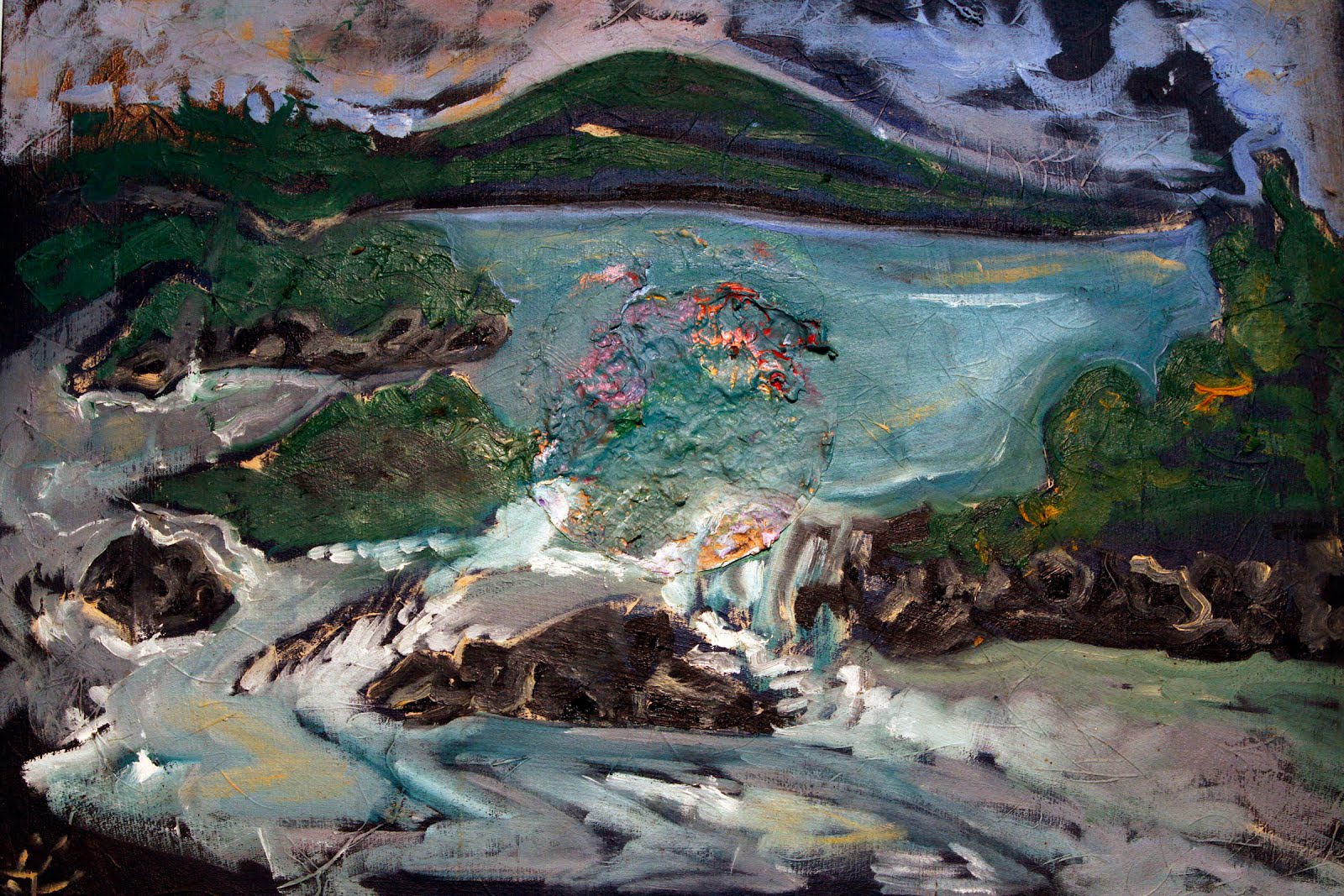
THE Afriart Gallery in Kamwokya, Kampala has just hosted a great line up of some of the best contemporary women artists working in Uganda in celebration of the Women Month of March.
The exhibition that ran from March 2 – 20, 2012, showcased the great advancements in art by top female artists displaying paintings, collages and photography. The display also included unique handmade earrings by Ugandan jewelers and other handcrafts.
The list of the exhibition titled, “Women artists in Uganda” includes: Stella Atal, Rosario Achola, Hellen Nabukenya, Maria Naita, Amanda Tumusiime, Sheila Nakitende, Meltem Yasar and Roshan Karmali.
Achola’s oil and mixed media display includes “The Lost Art of Romance,” “Bujagali” and “Fool’s Gold.” A picture of her painting “Bujagali” by Morgan Mbabazi appears above.
“Bujagali” explains the male element of economic development versus the female element of nature. With the building of the dam, a sacred place is going to be lost in the process. In the middle of the painting is the sacred area that is holding a secret of something more precious than gold.
“Fool’s Gold” is about the expectations of marriage. On the right is a man expressing his love and sexuality, he is the shining light, for his expectations are insemination reproduced by the fish and frogspawn below him. On the left is the bride and her expectations are fertility and a secure home. But these expectations break her neck.
Karmali, a photographer, designer and poet displayed her photographic collection tilted “Contemporary Tribe Series,” that included “Rachael,” “Jessica” and “Simone,” and?? Her series ask who is a tribe. What makes up a tribe? What is tribe?
“As long as we can remember tribes are made up of people who share the same traditions, cultures and a sense of unity, and look out and take care of each other. In the contemporary context as our cultures and ethnicities become diluted how does our generation connect to our indigenous heritage. So, we make a new (contemporary) tribe that takes strides or elements from our tradition and hold on to them in our contemporary lives,” Karmali observes.
“These series are about finding those people who function in life and keep alive their ancestry and cultural rituals despite being in the place that is changing. We tend to dilute our cultures with consumerism and the need to fit in and be the same. If we don’t celebrate our ancestry and tradition we are going to be creating generations of children who don’t connect, celebrate, indulge in the beauty and richness of our cultures. And this is not only happening in Africa but the other cultures in the world as well,” Karmali argues.
There was no better photo that summarized Karmali’s series than “Simone” - a portrait of a young woman of Burmese and American mixed race who has smeared herself with sandalwood paste as protection from the sun – a practice still in use in Burma. She lives in Washington DC, USA and this is a way of staying connected to her Burmese heritage.
Atal, a specialist in acrylics on barkcloth is also a fashion designer of wearable art. On display were her works like “My Sunshine,” “Beauty Contest” and “Rhythms of the Day” – carrying three fresh faces with beads, inspired to do something for the day.
Nakitende’s paintings included “Me Time,” “Strength of a Woman,” “First Love” and “My little friend.” While Tumusiime’s works are “Long Stride,” “Adolescent” and “Empowered.”
Nabukenya had “Blue land,” “Abstract,” “New Life,” “Love in Paradise” and “Advance.”
Naita’s works were “My Bouquet,” “Follow Your Dreams” and “My Best Friend,” among others.
Meltem’s marvelous photography made up of coloured and black and white portraits. Yasar, who seems to have fallen in love with nomadic peoples of western and eastern Africa has pictures of these people dressed in their traditional head gears, beads, burgles and hair styles. Most were captured in their homesteads in happy moods smiling with white beautiful teeth.
Meltem‘s collection include “Big smile from Omo Valley,” “Bottle cap girl,” “Lost in his eyes,” “Himba girl,” “Black-est eyes, beautiful smile,” “Scar tattooed Karamajong girl,” “Big Karamojong smile” and “Beauty in the crowd,” among others.
Achola, a surrealist painter and photographer described the exhibition as a way of expressing the different layers of what makes a woman, adding: “And it is also a way to examine the power dynamics in the different gender roles assigned to us by society.”
On her part Atal said: “I think it is a way of reaching out to other women showing them our talent by expressing our inner feelings through paintings and other forms of art.”
“We also want to prove to those who studied fine art and are not practicing thinking that it is a dirty job. Some people think painting is meant for men and not women, and that is why we are few women in this trade. So we want to challenge the men that we can do or even be better than them,” Atal added.
According to the curator of the Afriart Gallery, Daudi Karungi the exhibition showcased women’s creativity in Uganda with the purpose of displaying their works.
Ends.
Thursday, March 15, 2012
The Alchemist - A Testimony of Pursuing One’s Dreams
BY BAMUTURAKI MUSINGUZI
THE Alchemist is a story of Santiago, an Andalusian shepherd boy who dreams of travelling the world in search of a treasure as extravagant as any ever found.
In the classic novel by the Brazilian author and one of the world’s most popular spiritual writers, Paulo Coelho, the boy journeys from his home in Spain to the exotic markets of Tangiers and then into the Egyptian desert, where a fateful encounter with the alchemist awaits him.
The story begins with Santiago arriving with his herd at an abandoned church at dusk to spend a night. The roof has fallen in long ago, and an enormous sycamore had grown on the spot where the sacristy had once stood. He always carried a book and a heavy jacket that withstood the cold of the dawn.
It was still dark when he awoke amid a dream. He had had the same dream that night as a week ago, and once again he had awakened before it ended.
Santiago dreamt that he was in a field with his sheep, when a child appeared and began to play with the animals. He did not like people to do that, because the sheep are afraid of strangers. But children always seem to be able to play with them without frightening them. He did not know why. He did not know how animals know the age of human beings.
Suddenly, the child took both his hands and transported him to the Egyptian pyramids. The child said to him, “If you come here, you will find a hidden treasure.” And, just as she was about to show him the exact location, he woke up on both times.
He consulted an old woman who interpreted dreams; she encouraged him to go to Egypt after he promised to share his new riches with her.
Santiago then met the king of Salem. The treasure was in Egypt, near the pyramids, the old man informed the shepherd after he had handed over six sheep to the king.
He attended a seminary until he was sixteen. His parents had wanted him to become a priest, and thereby a source of pride for a simple farm family. The worked hard just to have food and water, like the sheep.
He had studied Latin, Spanish, and theology. But ever since he had been a child, he had wanted to know the world, and this was much more important to him than knowing God and learning about men’s sins. One afternoon, on a visit to his family, he had summoned up the courage to tell his father that he did not want to become a priest. That he wanted to travel after two years of walking the Andulusain terrain. He sold his herd of sheep and left for Africa.
All Santiago’s money was stolen when he got to Africa by a young man who pretended to assist him get to Egypt. He got employed by a crystal glassware merchant and the boy’s creative marketing ideas turned the glass business into a profitable venture. After eleven months and nine days in Africa, Santiago had saved enough money to buy himself a hundred and twenty sheep, a return ticket, and a license to import products from Africa into his own country. He had also learnt Arabic.
“When you want something, all the universe conspires to help you achieve it,” the old king had said. But he had not said anything about out being robbed, or about endless deserts, or about people who know what their dreams are but do not want to realize them.
One day after arriving at the Oasis of Al-Fayoum in Egypt, Santiago watched a pair of hawks flying high in the sky. Although their flight appeared to have no pattern, it made a certain kind of sense to him. It was just that he could not grasp what it meant, but he sensed that it was actually going to occur.
On the advice of the camel driver he met the tribal chiefs and relayed the omen of an impending invasion by the neighbouring tribe.
“The oasis is neutral ground. No one attacks an oasis,” one of the chiefs said. The chiefs agreed to break the agreement that forbid one from carrying arms on condition that if there was no invasion one of the arms would be used on the boy.
The boy was then confronted by a man on a white horse dressed in black, with a falcon perched on his left shoulder. “If the warriors come here, and you head is still on your shoulders at sunset, come and find me,” the horseman said. The boy had in fact met the alchemist.
The enemy attacked - and all but one of the intruders (the commander) were killed. The tribal chieftain called the boy, and presented him with fifty pieces of gold, and asked him to become the counselor of the oasis.
Later Santiago asked the alchemist: “Why did you want to see me?
“Because of the omens,” the alchemist answered. “The wind told me you would be coming, and that you would need help…”
“When a person really desires something, all the universe conspires to help that person to realize his dream,” said the alchemist, echoing the words of the old king.
“…You already know all you need to know. I am only going to point you in the direction of your treasure,” the alchemist said.
The boy replies that he has already found his treasures; a camel, money from the crystal shop, and fifty gold pieces. Besides that he had Fatima – a girl he had fallen in love with in Al-Fayoum.
“But none of that is from the pyramids,” said the alchemist.
On his way to the pyramids with the alchemist they were arrested after being mistaken for spies, and Santiago lost his gold coins to a chief. They were freed after the boy turned himself into wind.
When they got to a Coptic monastery the alchemist replaced the boy’s gold he had handed over to the general by turning lead into gold. Santiago parted ways with the alchemist before getting to the pyramids – the alchemist returned to the desert.
When he finally got to the pyramids, he began to dig for treasure. Throughout the night, the boy dug at the place he had chosen, but found no treasure.
He is attacked by a group of men, who beat him up and took his gold.
“What good is money to you if you’re going to die? It’s not often that money can save someone’s life,” the alchemist had said.
The boy eventually returned to the abandoned church. The sycamore was still there in the sacristy, and the stars could still be seen through the half-destroyed roof. This time he was not with his flock, but with a shovel.
He began to dig at the base of the sycamore. Half an hour later, this shovel hit something solid. An hour later, he had before him a chest of Spanish gold coins. There were also precious stones, gold masks adorned with red and white feathers, and stone statues embedded with jewels.
The Alchemist is an unforgettable novel about the essential wisdom of listening to our heart and, above all, following our dreams.
Ends.
THE Alchemist is a story of Santiago, an Andalusian shepherd boy who dreams of travelling the world in search of a treasure as extravagant as any ever found.
In the classic novel by the Brazilian author and one of the world’s most popular spiritual writers, Paulo Coelho, the boy journeys from his home in Spain to the exotic markets of Tangiers and then into the Egyptian desert, where a fateful encounter with the alchemist awaits him.
The story begins with Santiago arriving with his herd at an abandoned church at dusk to spend a night. The roof has fallen in long ago, and an enormous sycamore had grown on the spot where the sacristy had once stood. He always carried a book and a heavy jacket that withstood the cold of the dawn.
It was still dark when he awoke amid a dream. He had had the same dream that night as a week ago, and once again he had awakened before it ended.
Santiago dreamt that he was in a field with his sheep, when a child appeared and began to play with the animals. He did not like people to do that, because the sheep are afraid of strangers. But children always seem to be able to play with them without frightening them. He did not know why. He did not know how animals know the age of human beings.
Suddenly, the child took both his hands and transported him to the Egyptian pyramids. The child said to him, “If you come here, you will find a hidden treasure.” And, just as she was about to show him the exact location, he woke up on both times.
He consulted an old woman who interpreted dreams; she encouraged him to go to Egypt after he promised to share his new riches with her.
Santiago then met the king of Salem. The treasure was in Egypt, near the pyramids, the old man informed the shepherd after he had handed over six sheep to the king.
He attended a seminary until he was sixteen. His parents had wanted him to become a priest, and thereby a source of pride for a simple farm family. The worked hard just to have food and water, like the sheep.
He had studied Latin, Spanish, and theology. But ever since he had been a child, he had wanted to know the world, and this was much more important to him than knowing God and learning about men’s sins. One afternoon, on a visit to his family, he had summoned up the courage to tell his father that he did not want to become a priest. That he wanted to travel after two years of walking the Andulusain terrain. He sold his herd of sheep and left for Africa.
All Santiago’s money was stolen when he got to Africa by a young man who pretended to assist him get to Egypt. He got employed by a crystal glassware merchant and the boy’s creative marketing ideas turned the glass business into a profitable venture. After eleven months and nine days in Africa, Santiago had saved enough money to buy himself a hundred and twenty sheep, a return ticket, and a license to import products from Africa into his own country. He had also learnt Arabic.
“When you want something, all the universe conspires to help you achieve it,” the old king had said. But he had not said anything about out being robbed, or about endless deserts, or about people who know what their dreams are but do not want to realize them.
One day after arriving at the Oasis of Al-Fayoum in Egypt, Santiago watched a pair of hawks flying high in the sky. Although their flight appeared to have no pattern, it made a certain kind of sense to him. It was just that he could not grasp what it meant, but he sensed that it was actually going to occur.
On the advice of the camel driver he met the tribal chiefs and relayed the omen of an impending invasion by the neighbouring tribe.
“The oasis is neutral ground. No one attacks an oasis,” one of the chiefs said. The chiefs agreed to break the agreement that forbid one from carrying arms on condition that if there was no invasion one of the arms would be used on the boy.
The boy was then confronted by a man on a white horse dressed in black, with a falcon perched on his left shoulder. “If the warriors come here, and you head is still on your shoulders at sunset, come and find me,” the horseman said. The boy had in fact met the alchemist.
The enemy attacked - and all but one of the intruders (the commander) were killed. The tribal chieftain called the boy, and presented him with fifty pieces of gold, and asked him to become the counselor of the oasis.
Later Santiago asked the alchemist: “Why did you want to see me?
“Because of the omens,” the alchemist answered. “The wind told me you would be coming, and that you would need help…”
“When a person really desires something, all the universe conspires to help that person to realize his dream,” said the alchemist, echoing the words of the old king.
“…You already know all you need to know. I am only going to point you in the direction of your treasure,” the alchemist said.
The boy replies that he has already found his treasures; a camel, money from the crystal shop, and fifty gold pieces. Besides that he had Fatima – a girl he had fallen in love with in Al-Fayoum.
“But none of that is from the pyramids,” said the alchemist.
On his way to the pyramids with the alchemist they were arrested after being mistaken for spies, and Santiago lost his gold coins to a chief. They were freed after the boy turned himself into wind.
When they got to a Coptic monastery the alchemist replaced the boy’s gold he had handed over to the general by turning lead into gold. Santiago parted ways with the alchemist before getting to the pyramids – the alchemist returned to the desert.
When he finally got to the pyramids, he began to dig for treasure. Throughout the night, the boy dug at the place he had chosen, but found no treasure.
He is attacked by a group of men, who beat him up and took his gold.
“What good is money to you if you’re going to die? It’s not often that money can save someone’s life,” the alchemist had said.
The boy eventually returned to the abandoned church. The sycamore was still there in the sacristy, and the stars could still be seen through the half-destroyed roof. This time he was not with his flock, but with a shovel.
He began to dig at the base of the sycamore. Half an hour later, this shovel hit something solid. An hour later, he had before him a chest of Spanish gold coins. There were also precious stones, gold masks adorned with red and white feathers, and stone statues embedded with jewels.
The Alchemist is an unforgettable novel about the essential wisdom of listening to our heart and, above all, following our dreams.
Ends.
Subscribe to:
Posts (Atom)
